

Hi everyone,
Quick pop quiz: a Cal/OSHA inspector walks in right now and asks for your workplace violence prevention records. Does someone confidently pull up the folder? Or does everyone suddenly get very interested in the sterilization area?
Here's how to make sure it's the first one.
— Joyce
Are You Ready? Your Workplace Violence Prevention Records
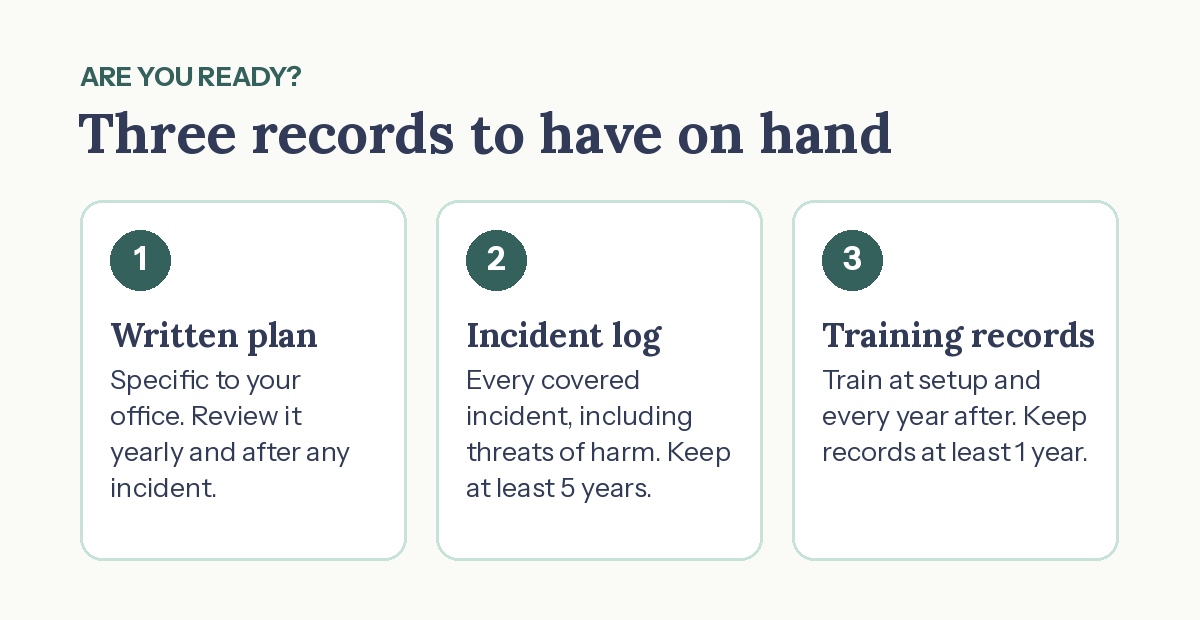
Under California Labor Code § 6401.9, most dental offices need a written Workplace Violence Prevention Plan, a violent incident log, training records, and a few other supporting records. That's a lot of paperwork, so let's start with the three that matter most.
1. A written plan that's actually about your office
Your plan has to be written down, easy for employees to get to, and specific to your office. A generic template you downloaded and never touched doesn't count.
Think about what could really happen at your practice: an upset patient at the front desk, someone closing up alone at night, or a team member who needs help fast when a situation gets tense. Your plan should cover those.
Review it at least once a year, after any incident, and anytime you spot a gap. And bring your team into it. They know where the risks are better than anyone.
2. The violent incident log
Every incident covered by the law goes in the log. And "violent" covers more than you might think: physical attacks, threats of physical force, incidents involving weapons, and a few other specific situations.
Grabbing, biting, or spitting can count as a physical attack. Threatening words can count when they show an intent to hurt someone or make a person reasonably afraid of being hurt.
That said, not every grumpy patient belongs in the log. Someone complaining loudly about their bill is unpleasant, but that doesn't automatically make it a reportable incident. Check what happened against the law's definitions instead of logging every bad day.
The log needs certain details about each incident, but no names or other personal identifying information about the people involved. Keep your incident logs for at least five years.
3. Training records (and the paperwork behind them)
Everyone covered by the plan needs training when the plan is first set up, then again every year. The training has to be about your office's plan and your office's risks, and people need a real chance to ask questions of someone who knows the plan. (A video playing in the break room during lunch doesn't quite get there.)
Keep training records for at least one year. They need to show:
- The date of the training
- What was covered, or a summary
- Who led it, and their qualifications
- Who attended, and their job titles
Don't forget the behind-the-scenes records, too: how you identified, evaluated, and fixed hazards, plus any incident investigations. Those generally need to be kept for at least five years.
A question we heard this fall: "We're a small team. Do we really need all this?"
Probably, yes. The small-office exception is narrow. It only applies if you have fewer than 10 employees, your workplace isn't open to the public, and you follow the Injury and Illness Prevention Program rules. Since your whole business is welcoming patients through the door, a typical dental office can't use it.
If finding any of these records today would turn into a scavenger hunt, that's your sign to look at the whole system, not just the paperwork.
We can help your office build a plan that fits how you actually work, train your team, and get your records organized so you're ready when someone asks.
Coming Up Next Tuesday
Can't touch this: your hygienist learned pulp vitality testing in school, so why might they not be allowed to do it at work? It all comes down to one date: January 1, 2006.
Renewing your license this year?
Every California dental license renewal needs 2 units of Infection Control and 2 units of the California Dental Practice Act. You can finish both online, at your own pace, and your CE certificate is emailed to you when you’re done.
- California Infection Control, 2 units, $75
- California Dental Practice Act, 2 units, $75
Office managers: if several people on your team are renewing this year, reply to this email and we’ll get them all set up.
Best,
Joyce Weeks, BS, MSc
Owner & Lead Compliance Educator
Dental Ed, Inc.
760-930-9401 | [email protected]
Dental Ed provides educational information to support dental-office compliance. This newsletter is not a substitute for legal advice or review of your office's specific circumstances.

Responses