

You're receiving Beyond the Binder because you're part of the Dental Ed community. It's free, it arrives every Tuesday, and you can unsubscribe anytime using the link at the bottom of this email.
A Note from Joyce
Hi everyone,
It's flu season. Somewhere out there, a patient is walking up to your front desk, sniffling, and saying, "Oh, it's just allergies."
So this month we're kicking off something I've wanted to do for a long time: Bug of the Month. Once a month, we'll pick one germ, get to know it a little too well, and talk about how to keep it out of your office. Think of it as a wanted poster, with fewer cowboys and more PPE.
Why bother? Because once you understand the bug, the rules stop feeling random. "Wipe it down" makes a lot more sense when you know exactly what you're wiping away.
First up: influenza. Let's meet our villain.
— Joyce
Bug of the Month: Influenza
Meet the bug
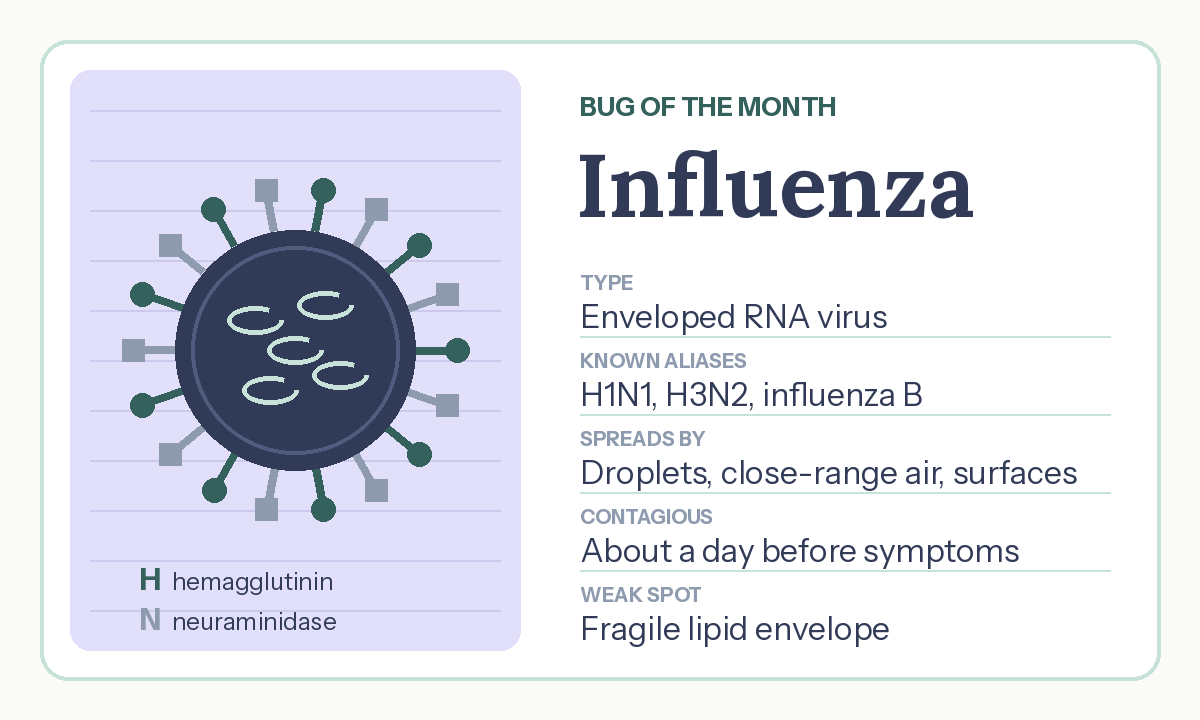
Influenza is a virus, and it has two main troublemakers: flu A and flu B. Between them, they're behind most of the flu that rolls through every winter.
Flu wears two "name tags" or proteins on its surface, called H and N. That's where names like H1N1 and H3N2 come from.
Your immune system learns to recognize those name tags. So what does flu do? It keeps changing them. A small tweak here, a small tweak there, and next year your body doesn't recognize it as easily. That's why there's a new flu shot every fall. It's not a scheme to get you back to the pharmacy. The bug is just a master of disguise.
Every so often, flu skips the small tweaks and shows up with a completely new look. When almost no one's immune system recognizes it, it can spread around the world. That's what happened with the H1N1 pandemic in 2009.
How it spreads
Flu travels mostly in the droplets people release when they talk, cough, or sneeze. Tiny particles can also hang in the air indoors for a while. And sometimes it hitches a ride on a surface: someone touches a contaminated counter, then rubs their eyes, nose, or mouth. CDC: How Flu Spreads
Two reasons dental offices should pay extra attention:
1. People spread flu before they feel sick. Someone with the flu can pass it on starting about a day before symptoms show up, and for roughly five to seven days after. So the patient who feels totally fine at check-in? They could still be sharing.
2. Your job is literally in people's faces. You work up close, for a long time, often with spray flying. Flu could not have designed a better workplace if it tried.
How we stop it
Here's the good news: flu is kind of a wimp.
It's wrapped in a thin, fatty outer coat (scientists call it an "envelope"). Damage that coat, and the virus can't infect anyone.
Soap and water break it apart. Alcohol hand rub takes it out. For surfaces, use an EPA-registered hospital disinfectant that lists influenza on the label, and keep the surface wet for the full contact time the label says. (Flu may be a wimp, but norovirus is not. We'll get to that bug another month.)
The best defense comes in layers:
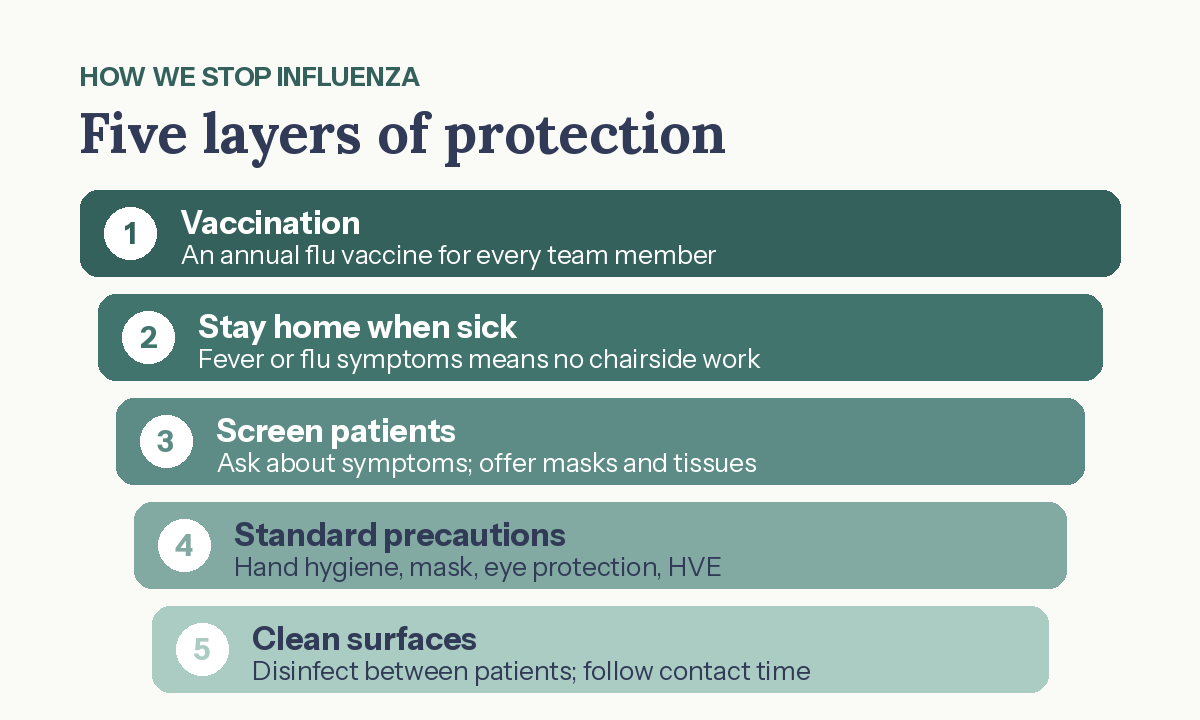
Get vaccinated. The yearly flu shot is the single best way to protect yourself, your team, your patients, and everyone's grandma.
Stay home when you're sick. Coming to work with a fever isn't dedication. It's distribution. Make sure your team knows the sick-day plan now, before the season peaks.
Screen your patients. Ask about cough, fever, and other symptoms when you confirm appointments, and again at check-in. Keep masks and tissues out front. If a patient is clearly sick, follow your office's process for rescheduling nonurgent care.
Use standard precautions with every patient. That means hand hygiene, plus masks, eye protection, and other PPE that fit the procedure. High-volume suction keeps the spray from going anywhere it shouldn't.
Disinfect between patients. Wipe down clinical contact surfaces after every patient, following the product directions.
No single layer is perfect. Stack them up, and flu has a very hard time getting through.
Myth vs. fact
Myth: "The flu shot gave me the flu."
Fact: It didn't. The flu shot can't give you the flu, because the injectable vaccines don't contain live virus that can make you sick. (The nasal spray version uses a weakened live virus, but it doesn't cause the flu either.) A sore arm or feeling tired for a day is your immune system doing its homework. It's not influenza.
Myth: "I've got the stomach flu."
Fact: That's usually not influenza at all. Flu is a respiratory illness. Vomiting and diarrhea usually come from a different bug, often norovirus. Same nickname, totally different villain.
Myth: "I got a flu shot last year, so I'm covered."
Fact: Protection fades over time, and remember, the virus changes its disguise every year. You need a fresh shot every season.
Coming Up Next Tuesday
Are you ready? If a OSHA inspector walked in today and asked for your workplace violence prevention records, could you hand them right over? Or would someone suddenly need to "go check in the back"? Next week, we'll walk through the three records to check first.
And mark your calendar: on December 1, World AIDS Day, HIV takes the spotlight as our next Bug of the Month.
Until then, wash your hands, wipe your surfaces, and go get that flu shot. Your arm will forgive you.
Warmly,
Joyce Weeks, BS, MSc
Owner & Lead Compliance Educator
Dental Ed, Inc.
760-930-9401 | [email protected]
Dental Ed provides educational information to support dental-office compliance. This newsletter is not a substitute for legal advice or review of your office's specific circumstances.


Responses